How Many Brake Pads Are on a Car? (Full 2026 Guide)
If you’ve ever asked yourself “how many brake pads are on a car?” you’re not alone. Most drivers assume the answer is simple—but the truth depends on your car’s braking system, and it can actually confuse even experienced vehicle owners.
In this detailed guide, we’ll break everything down in a realistic, easy-to-understand way so you know exactly how many brake pads your car has, how they work, and why this matters for safety and maintenance.
We’ll also connect everything to real-world vehicle service knowledge, similar to what professional mechanics use daily and what you can expect from automotive parts suppliers like Mitsubishi Auto Store.
Why Brake Pads Matter More Than You Think
Brake pads are one of the most important safety components in any vehicle. Every time you press the brake pedal, these small parts create the friction needed to stop your car safely.
Without them, your car would not be able to slow down properly—no matter how powerful the engine is.
Brake pads:
- Create friction against brake rotors
- Convert motion energy into heat
- Help control stopping distance
- Protect your wheels and braking system
Because they wear out over time, understanding how many are in your car is essential for maintenance and budgeting.
So, How Many Brake Pads Are on a Car?
Let’s get straight to the answer:
Most modern cars have 8 brake pads in total
This applies when the car has disc brakes on all four wheels.
Here’s the breakdown:
- Each wheel has 2 brake pads
- One inner pad
- One outer pad
- A car has 4 wheels
So:
2 pads × 4 wheels = 8 brake pads total
This is the most common configuration in today’s passenger vehicles like sedans, SUVs, and hatchbacks. (Car Mechan)
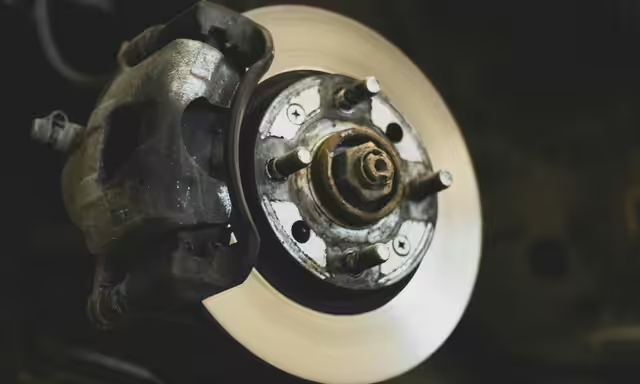
Why Each Wheel Needs Two Brake Pads
A common misconception is that each wheel has only one brake pad. That’s incorrect.
Every disc brake system works using a caliper, which acts like a clamp.
Inside that caliper are:
- One pad on the inner side of the rotor
- One pad on the outer side of the rotor
When you press the brake pedal:
- Hydraulic pressure pushes the caliper
- Both pads squeeze the spinning rotor
- Friction slows the wheel down
How many brake pads are on a car dual-pad system ensures:
- Balanced braking force
- Smooth stopping
- Even wear on the rotor
Without two pads per wheel, braking would be unstable and unsafe.
Different Cars Have Different Brake Pad Counts
Not every car follows the “8 brake pads” rule. The total depends on the braking system installed.
Let’s break it down.
1. Cars with Front Disc + Rear Drum Brakes
Some budget or older vehicles use:
- Disc brakes in the front
- Drum brakes in the rear
In this case:
- Only the front wheels have brake pads
- Rear wheels use brake shoes instead of pads
Total brake pads: 4 brake pads (front only)
This system is cheaper but less powerful than full disc brakes.
2. Cars with Four-Wheel Disc Brakes (Most Modern Cars)
How many brake pads are on a car is the most common setup today.
- Front wheels = disc brakes
- Rear wheels = disc brakes
Total brake pads: 8 brake pads
How many brake pads are on a car is the standard for most modern vehicles because it provides:
- Better stopping power
- Better heat control
- Safer braking performance
3. High-Performance Cars (Special Cases)
Sports cars or modified vehicles may use:
- Larger calipers
- Multi-piston systems
- Advanced braking setups
In rare cases, brake pad systems may differ slightly, but the concept still remains:
Each rotor still requires inner + outer pads
So the total may remain 8, but the design is more advanced.
Front vs Rear Brake Pads: Are They the Same?
No—they are not the same.
Even though the total number is usually 8, the front and rear pads are different in:
- Size
- Material
- Wear rate
Why?
Because braking force is not evenly distributed.
- Front brakes handle about 70% of stopping power
- Rear brakes handle about 30%
This means:
- Front brake pads wear out faster
- Rear brake pads last longer
That’s why mechanics often replace front pads more frequently.

Do All Cars Have Brake Pads?
No.
Some vehicles use:
- Disc brakes → use pads
- Drum brakes → use shoes
So if your car has drum brakes in the rear, you won’t have rear brake pads at all.
How many brake pads are on a car is why checking your car model matters before assuming the number.
How Brake Pads Work (Simple Explanation)
To understand the count better, you need to understand the system.
When you press the brake pedal:
- Brake fluid pushes pistons inside calipers
- Calipers squeeze brake pads
- Pads clamp onto the rotor
- Friction slows the wheel
How many brake pads are on a car process happens in milliseconds and is repeated thousands of times every trip.
Why Brake Pads Come in Sets
When you buy brake pads, you usually don’t buy just one pad.
Instead, they are sold as:
- Front axle set (4 pads)
- Rear axle set (4 pads)
Why?
Because:
- Braking must be balanced
- Uneven replacement causes instability
- Safety standards require axle replacement
How Often Should Brake Pads Be Replaced?
Brake pads do not last forever.
Typical lifespan:
- 30,000 to 70,000 miles (varies widely)
They wear faster if:
- You drive in traffic often
- You brake hard frequently
- You carry heavy loads
- You drive in hilly areas
Warning signs include:
- Squeaking noise
- Grinding sound
- Vibration when braking
- Longer stopping distance
Signs Your Brake Pads Are Worn Out
You should always monitor brake performance.
Common symptoms:
- High-pitched squealing
- Metal grinding sound
- Brake warning light
- Soft brake pedal
- Car pulling to one side
Ignoring these signs can damage rotors, making repairs more expensive.
Why Knowing Brake Pad Count Matters
Understanding how many brake pads are on your car helps you:
- Avoid overpaying at workshops
- Understand repair quotes
- Maintain safety
- Plan replacement costs
Many drivers get confused when mechanics say:
- “Front set”
- “Rear set”
- “Axle replacement”
Now you know exactly what those terms mean.
Quick Summary (Important Points)
- Most cars = 8 brake pads total
- Each wheel = 2 brake pads
- Some cars = only 4 brake pads (front only)
- Rear drum brakes = no pads
- Front pads wear faster than rear
- Pads are always replaced in axle sets
Final Thoughts
So, how many brake pads are on a car?
The simple answer is:
Usually 8 brake pads, but it can be 4 depending on your braking system.
What matters most is not just the number—but understanding how your specific vehicle is designed.
If you regularly maintain your brakes and understand how they work, you’ll not only save money but also drive much safer on the road.
And if you ever need replacement parts or automotive support, reliable sources like Mitsubishi Auto Store can help you find the right components for your vehicle.