
We’ve all been there: that sickening, hollow “thud” in a crowded parking lot followed by an immediate, heavy sink in your chest. In that split second, your car is no longer just a vehicle; it’s a sudden, unplanned financial question mark. You find yourself staring at the scuff or the dent, wondering, “How much does it cost to repair car bumper surfaces in today’s market?
The 2026 Reality
If you haven’t dealt with auto body work in a few years, the estimate might come as a shock. In 2026, bumpers have evolved far beyond simple plastic covers. They are now “tech-heavy safety shells.” What looks like a minor cosmetic scratch on the outside often hides a complex network of ultrasonic parking sensors, blind-spot radar, and cameras.
Repairing a bumper today isn’t just about sanding and painting; it’s about delicate hardware and software recalibration. At MitsubishiAutoStore.com, we see firsthand how integrated technology has shifted the repair landscape, making professional expertise more critical than ever.
The Core Answer: What’s the Damage?
To satisfy that immediate need to know, here is the current price breakdown for 2026:
- Minor Cosmetic Scuffs: $150 – $600 (Paint touch-ups and surface blending).
- Traditional Dent Repair: $300 – $900 (Requires pulling, filling, and respraying).
- Full Replacement & Tech Calibration: $1,200 – $2,500+ (Common for modern vehicles with ADAS sensors).
While the range is wide, most standard repairs fall into the $600 to $1,200 bracket. Understanding where your specific damage sits on this scale is the first step toward getting your car back to showroom quality.
Breaking Down the Bill: What Does Your Bumper Damage Actually Cost?
When you take your car to a body shop, the technician isn’t just looking at the size of the mark; they are diagnosing the “type” of trauma your vehicle sustained. To help you budget effectively, let’s pull back the curtain on how professionals categorize damage and what it means for your wallet.

1. The Cosmetic Scuff ($150 – $600)
This is the most common form of “parking lot rash.” It includes paint chips, spiderweb cracks in the clear coat, or surface scratches from a wayward shopping cart.
While it’s tempting to ignore a small scuff, paint blending is where the real value lies. A professional doesn’t just “dab” paint on the scratch; they feather the new pigment into the surrounding panels. This ensures that under direct sunlight, the repair is invisible. For those looking to maintain a high resale value, a seamless blend is the difference between a “well-maintained” car and one that looks like it’s hiding an accident.
2. The “Standard” Dent ($250 – $800)
If your bumper is pushed in but the paint hasn’t cracked, you might be a candidate for Paintless Dent Repair (PDR). This is a specialized technique where technicians use metal rods to “massage” the plastic or metal back into its original shape from the inside out.
PDR ($250 – $500): Fast, eco-friendly, and preserves your factory paint.
Traditional Bodywork ($500 – $800): If the dent is too sharp or the plastic is stretched, the shop must use heat, traditional pulling tools, and a fresh coat of paint to restore the finish.
3. The Structural Crack ($600 – $1,200)
A crack is a game-changer. Once the bumper’s plastic integrity is compromised, it can no longer absorb impact as designed. However, if a replacement is too expensive or the part is rare, shops use industrial-strength epoxy resins and plastic welding.
The process involves “v-ing” out the crack, filling it with a flexible structural adhesive, sanding it flush, and then performing a full respray. This is labor-intensive work, but it’s a highly reliable way to save an original bumper—especially for enthusiast vehicles where original fitment is everything.
The “Hidden” Tech Tax: Why Modern Bumper Repairs Cost More Than You Think
In the “good old days,” a car bumper was exactly what the name implied: a sturdy piece of metal or plastic designed to take a bump so your engine didn’t have to. If you hit a pole, you swapped the plastic cover, and you were back on the road.
Fast forward to 2026, and your bumper is no longer just a shield—it’s a sophisticated high-tech nerve center. If you’ve been shocked by a repair estimate recently, you’ve likely encountered the “Hidden Tech Tax.”
The “Eyes” of Your Car
Modern bumpers are the primary housing for your vehicle’s Advanced Driver Assistance Systems (ADAS). When you look at a bumper today, you aren’t just looking at paint; you are looking at the mounting points for:
- Ultrasonic Sensors: Those tiny circular “buttons” that beep when you get too close to a wall.
- Radar Units: Tucked behind the plastic, these “see” through rain and fog to manage your Adaptive Cruise Control and Blind-Spot Monitoring.
- Cameras: Often integrated into the front grille or rear bumper to provide 360-degree bird’s-eye views.
Because these components are located at the furthest edges of your vehicle, they are the first things to break in even a minor 5 mph fender bender.
Calibration: The Software Alignment ($300 – $800)
The biggest surprise on a modern repair bill isn’t the cost of the plastic—it’s the calibration fee.
Imagine a laser pointer attached to your bumper. If that bumper is shifted by even one millimeter during a collision or a repair, that laser (the radar) might be pointing at the ground or into the sky instead of at the car in front of you.
Calibration is the process of digitally aligning these sensors so the “brain” of the car knows exactly where they are pointing.
- Static Calibration: Requires a specialized environment with specific targets placed around the car.
- Dynamic Calibration: Involves driving the car at specific speeds on marked roads while connected to a diagnostic computer.
This process requires specialized equipment and hours of a technician’s time. You aren’t just paying for a “plug and play” part; you are paying for the precision software engineering that ensures your Automatic Emergency Braking actually stops the car when it matters most.
Vehicle Variables: Why an “Evo” Fix Costs More Than a Standard Sedan
When you start researching how much does it cost to repair car bumper damage, you’ll quickly notice that the “average” price doesn’t apply to everyone. Your car’s DNA—whether it’s a daily commuter or a high-performance legend—dictates exactly how deep you’ll have to dig into your pockets.
Everyday Drivers: Practical and Predictable
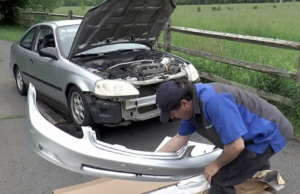
For standard economy cars and SUVs, bumper repairs are relatively straightforward. Because these vehicles are produced in high volumes, parts are readily available, and aftermarket options are plentiful.
- Standard Parts: High availability means lower shipping costs and competitive pricing.
- Lower Labor Hours: Most shops are intimately familiar with the assembly of high-volume models, meaning they can “R&I” (remove and install) the bumper in record time.
- Simple Finishes: Most economy cars use single-stage or basic two-stage paints that are easy to match and blend.
Specialty & Performance: The Enthusiast’s Price
On the other side of the spectrum are performance icons like the Mitsubishi Lancer Evolution X. If you’re driving an “Evo,” your bumper isn’t just a plastic cover—it’s a piece of aerodynamic engineering.
- Specialized Aerodynamics: Performance bumpers often feature integrated splitters, larger air intakes for the intercooler, and specific ducting for brake cooling. These complex shapes require more time to prep and paint.
- Premium Materials: It’s not uncommon to find carbon fiber accents or reinforced composites on performance trims. Repairing or replacing carbon fiber is significantly more expensive than standard ABS plastic.
- Unique Paint Finishes: Many high-performance Mitsubishis come in stunning colors like Phantom Black or tri-coat pearls. These “multi-stage” paints require extra layers of base, mid-coat, and clear, doubling the material cost and the labor time required for a perfect blend.
The Verdict
Whether you are cruising in a reliable Mirage or tearing up the track in an Evolution X, the complexity of your vehicle is the ultimate price driver. While a standard repair might stay on the lower end of the spectrum, performance owners should budget for the specialized care their machines require.
No matter what you drive, using high-quality components is the best way to protect your investment. Explore the right parts for your specific model at MitsubishiAutoStore.com.
Repair vs. Replace: When Should You Let Go?
When assessing how much does it cost to repair car bumper damage, you eventually hit a crossroads: do you patch up the old one or start fresh with a new part? Making the wrong choice can lead to “ghost repairs” that fail months later or unnecessary spending on a part that could have been saved.
The 80% Rule
In the auto body world, we use a simple benchmark known as the 80% Rule. If the labor and material costs to professionally sand, fill, and respray your existing bumper exceed 80% of the cost of a brand-new OEM part, it is time to replace it.
Why? Because a new bumper offers a factory-perfect finish and structural integrity that a heavily patched unit simply cannot match. It’s often more cost-effective to buy a fresh “skin” from MitsubishiAutoStore.com and pay for painting than to pay a technician for eight hours of tedious plastic surgery on a mangled part.
Safety First: The Internal Reality
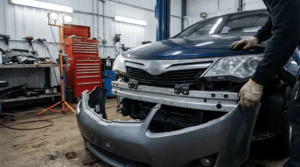
Sometimes, the decision isn’t about money—it’s about survival. Modern bumpers consist of a plastic “cover” (the part you see) and a structural bumper beam (the part that saves your life).
Even if the outer plastic skin looks fine after a low-speed bump, the internal beam or energy absorber may be cracked or compressed. Once that beam is compromised, it cannot protect you in a second accident. If a professional inspection reveals a cracked internal reinforcement, a mandatory replacement is the only safe path forward.
Saving Money Without Cutting Corners
We all want to keep our hard-earned cash in our pockets, but when it comes to bumper repairs, the “cheapest” route can often become the most expensive one six months down the line. Here is how to save intelligently without compromising your car’s safety or appearance.
The Insurance Strategy: Do the Math
Before you call your agent, run the Deductible Math. Most bumper repairs in 2026 fall between $600 and $1,200. If your deductible is $1,000, you are only gaining $200 in coverage while risking a future premium hike. Generally, if the repair cost is within $300–$500 of your deductible, paying out of pocket is the smarter long-term financial move.
Parts Selection: Finding the Middle Ground
You don’t always need a brand-new factory part to get a factory look.
- OEM (Original Equipment Manufacturer): Best for cars under 3 years old or those with complex integrated sensors.
- High-Quality Aftermarket: Parts with CAPA certification offer a reliable fit at 30–50% less than OEM prices.
- Recycled (LKQ): Buying a “Like Kind and Quality” bumper from a recycler is a secret weapon. You get a genuine factory part at a fraction of the price—and if you’re lucky, you might find one already painted in your car’s color!
DIY Limits: Know When to Stop
A $20 touch-up pen is perfect for tiny stone chips or a fingernail-sized scratch. However, be wary of “canned” spray paint. Modern automotive finishes are applied in dust-free booths with specific pressure settings. Attempting a large DIY spray job on your bumper often results in a “matte” or “orange peel” texture that looks obvious under sunlight.
FAQ
1. How much does it cost to repair a bumper in 2026?
The cost generally ranges from $150 to $2,500. Minor surface scuffs are on the lower end ($150–$600), while a full replacement involving sensor recalibration typically starts at $1,200 and can exceed $2,500 for luxury or performance vehicles like the Evolution X.
2. Is it better to repair or replace a car bumper?
Follow the 80% Rule: if the cost to repair the damage exceeds 80% of the price of a new part, replacement is the better investment. Additionally, if the bumper has structural cracks or broken mounting tabs, a full replacement is necessary for safety.
3. Does insurance cover bumper repair?
Yes, typically under Collision Coverage (if you hit something) or Comprehensive Coverage (if something hits you, like a falling branch). However, if the repair cost is close to your deductible, paying out of pocket may prevent future premium increases.
4. Why is bumper repair more expensive now than it was a few years ago?
Modern bumpers are “smart.” They house ADAS technologies such as parking sensors and blind-spot monitors. After a repair, these sensors require professional calibration (costing $300–$800) to ensure safety features like the automatic braking function work correctly.
5. Can I fix a bumper dent myself?
For small, shallow dents where the paint isn’t cracked, you can use a DIY suction tool or the “boiling water” method. However, for deep creases or anything involving electronics, professional repair is recommended to maintain the vehicle’s structural integrity and resale value.
Conclusion
When asking how much does it cost to repair car bumper damage, it is easy to get lost in the numbers. However, it is vital to remember that your bumper is more than just a piece of plastic; it is a sacrificial safety component engineered to absorb impact and protect your life. Ignoring a crack or a misaligned sensor isn’t just a cosmetic choice—it’s a safety risk.
Treating your bumper repair as optional can lead to higher costs down the road and compromised protection in a future collision. Whether you decide to go with a minor professional touch-up or a full structural replacement, prioritize quality and precision over the “quick fix.”