Where Is the Gas and Brake in an F1 Car? The Complete Guide to F1 Pedal Systems
If you’ve ever watched a Formula 1 race and wondered how drivers control those 200+ mph machines, you’re not alone. One of the most common questions fans ask is: where is the gas and brake in an F1 car? The answer is more fascinating — and more surprising — than most people expect.
From a two-pedal setup to left-foot braking techniques and carbon-fiber pedal boxes, the world of F1 footwork is a masterclass in performance engineering. And for those of us who love pushing our own cars to the limit — whether that’s a Mitsubishi Lancer Evolution, Eclipse, or a track-prepped Galant — understanding F1 technology gives us incredible insight into what separates good driving from great driving.
Let’s break it all down.
The Basic Layout: Where Are the Pedals in an F1 Car?
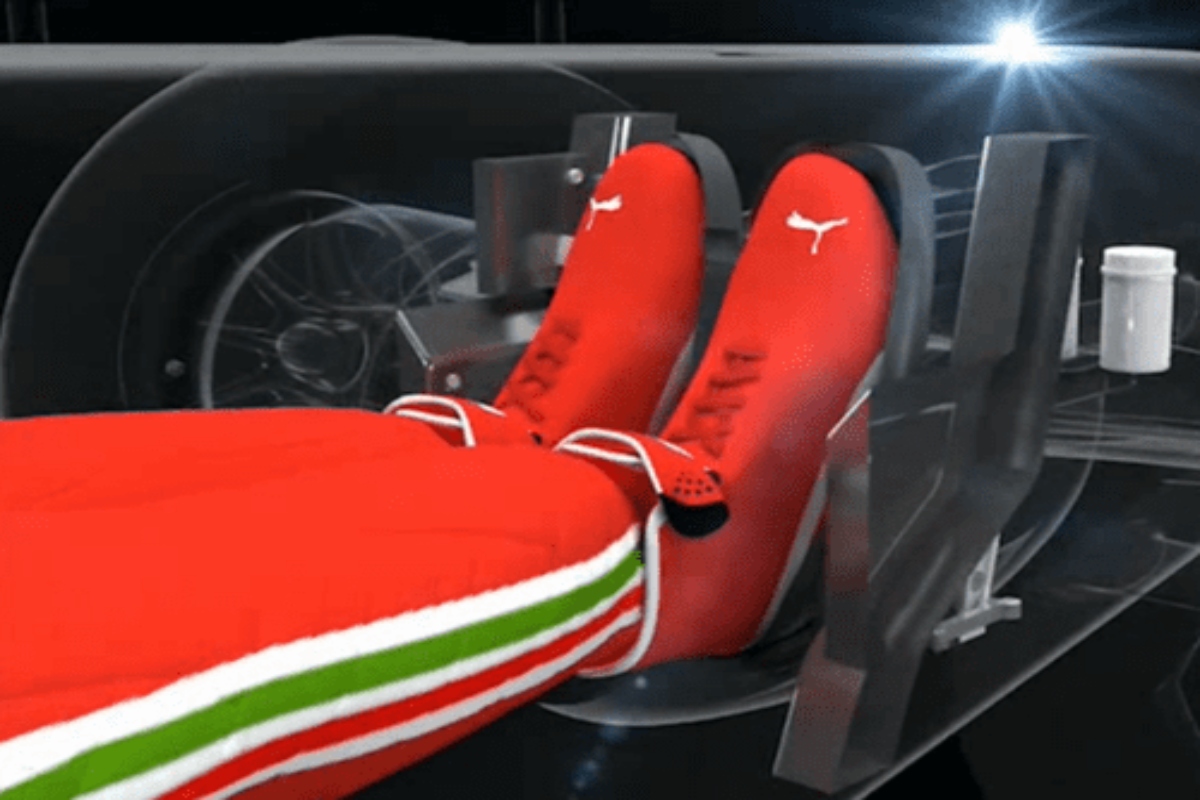
In a modern Formula 1 car, the pedals are located at the very front of the chassis, tucked inside an extremely narrow carbon fiber monocoque. The driver’s legs extend almost horizontally toward the nose of the car, with the feet operating pedals that are positioned at roughly the same height as the driver’s hips.
Here’s what you’ll typically find:
The Accelerator (Gas Pedal) — Located on the right side, just as in a road car. F1 throttle pedals are incredibly sensitive, with drive-by-wire systems translating the slightest foot movement into precise engine output. Modern F1 power units are hybrid systems, meaning the accelerator doesn’t just control the internal combustion engine — it also manages the deployment of the Motor Generator Unit (MGU-K), which can deliver up to 120 additional horsepower instantly.
The Brake Pedal — Located on the left (or center-left). This is where things get interesting. Most road cars have the brake in the center and the accelerator on the right, with a dead pedal to the far left. In an F1 car, the brake pedal is designed to be operated almost exclusively with the left foot, which is a fundamental departure from how most road drivers were taught.
There is no clutch pedal in the conventional sense for most race situations. F1 cars use semi-automatic, paddle-shift gearboxes mounted behind the steering wheel. The clutch paddles are used only for race starts and pit lane exits. Once the car is moving, all gear changes happen via those carbon fiber paddles with gear shifts completed in around 50 milliseconds — faster than you can blink.
Why F1 Cars Only Have Two Pedals (Not Three)
Where is the gas and brake in an f1 car surprises many people. Most of us learned to drive with three pedals: clutch, brake, accelerator. In an F1 car, you won’t find a floor-mounted clutch pedal during a race.
The reason goes back to the evolution of transmission technology. Since the late 1980s and early 1990s, teams like Ferrari and Williams pioneered semi-automatic gearboxes controlled by electro-hydraulic systems. By 1994, virtually every top team had eliminated the manual clutch pedal entirely from the driver’s footwell for on-track use.
This was a revolution. It freed up the driver’s left foot from clutch duty entirely — and that foot now had one critical, high-performance job: braking.
Where is the gas and brake in an f1 car technique, known as left-foot braking, is something that elite drivers have refined into an art form. By keeping the right foot on the throttle and using the left foot to modulate the brakes, drivers can overlap throttle and braking inputs to maintain turbo pressure, rotate the car more precisely under corner entry, and shave fractions of seconds from each lap.
A Deep Dive into Left-Foot Braking
Left-foot braking in F1 is not simply about which foot pushes the pedal. Where is the gas and brake in an f1 car represents an entirely different philosophy of car control.
When a driver approaches a braking zone at 200 mph, they need to:
- Reduce speed from, say, 200 mph to 60 mph in under two seconds
- Trail the brakes into the corner apex to maintain balance
- Begin applying throttle while still lightly on the brakes
- Achieve full throttle as early as possible for maximum exit speed
In a road car, overlapping throttle and brake is generally considered bad form — it wastes fuel, overheats brakes, and causes unnecessary wear. But in an F1 car, this overlap is precise, deliberate, and measured in milliseconds. It keeps the turbo spinning (reducing turbo lag), loads the front tires for sharper turn-in, and gives the driver tactile feedback about the balance of the car.
Championship-winning drivers like Ayrton Senna helped popularize and perfect this technique in the late 1980s. Today, every F1 driver on the grid uses left-foot braking as standard practice.
The F1 Pedal Box: Engineering at Its Finest
The pedal assembly in an F1 car is called the pedal box, and where is the gas and brake in an f1 car a marvel of precision engineering. Here’s what goes into it:
Carbon Fiber Construction — The pedal box itself, including the pedals and mounting hardware, is made almost entirely from carbon fiber composite materials. This keeps the weight to an absolute minimum — critical when the entire car must weigh no more than 798 kg (including driver) per 2024 FIA regulations.
Adjustability — The entire pedal assembly can be moved forward or backward to accommodate drivers of different heights. When a team changes drivers — or a driver moves between teams — the mechanics spend significant time adjusting the pedal position, sometimes to within a millimeter of the driver’s specification.
Brake Bias Adjuster — Inside the cockpit, drivers have a brake bias dial or wheel that allows them to shift braking force between the front and rear axles in real time. More front bias helps with turn-in but can cause understeer; more rear bias rotates the car but risks locking the rears. Adjusting this while cornering at racing speed is a genuine skill.
Throttle-by-Wire — Unlike older mechanical linkages where a cable connected the pedal directly to the throttle butterfly, modern F1 cars use electronic throttle control. The pedal feeds data to the ECU, which then commands the engine and hybrid systems. This allows incredibly fine control and enables safety systems that prevent the driver from accidentally wheelspin-damaging the power unit.
Brake-by-Wire (Rear Axle) — Since the introduction of the ERS (Energy Recovery System), F1 cars have used brake-by-wire on the rear axle. The system blends traditional hydraulic braking with regenerative energy recovery, and the ECU manages the balance seamlessly. From the driver’s perspective, it still feels like a conventional brake pedal — but the engineering behind it is extraordinarily complex.
How F1 Drivers Train Their Feet
You can’t simply sit in an F1 car and use the pedals effectively without serious training. F1 drivers condition their legs and feet specifically for the demands of the cockpit.
Leg Strength — Under hard braking, an F1 driver can experience deceleration forces of 5G or more. In practical terms, that means the pedal can require up to 100 kg of force to achieve maximum braking performance. Drivers train extensively to develop the quad strength, hamstring stability, and ankle precision to control this consistently through 50+ laps.
Sensitivity Training — At the same time, the throttle pedal requires extraordinary sensitivity. The difference between optimal traction and a spin can be a matter of a few percent of throttle opening. Drivers work with simulators — often running thousands of laps per season in high-fidelity virtual environments — to develop the muscle memory needed to modulate inputs with such precision.
Conditioning for G-Forces — The lateral G-forces through high-speed corners also affect pedal control. When a driver is experiencing 4–5G of lateral force through a high-speed corner, maintaining precise foot pressure requires core strength and physical conditioning that goes far beyond what normal fitness routines provide.
How This Compares to High-Performance Road Cars
Now, here’s where is the gas and brake in an f1 car gets relevant for those of us who love performance vehicles on the road and track.
The Mitsubishi Lancer Evolution — arguably one of the greatest performance sedans ever built — uses a layout much closer to standard: three pedals in manual form, or two in the SST twin-clutch automatic variant. But the performance DNA between an Evo and an F1 car shares remarkable DNA.
The Evo’s legendary all-wheel-drive system, its turbocharged 4B11T engine, and its advanced torque vectoring differential were all designed with one goal: to put power to the ground as efficiently as possible. That’s the exact same philosophy F1 engineers employ when designing pedal systems, traction control maps, and hybrid energy deployment strategies.
If you drive a Mitsubishi Lancer Evolution on track and practice left-foot braking (which is far more accessible in an AWD car than in rear-wheel-drive machines), you’ll immediately begin to understand the principles F1 drivers use. Trail braking into corners, maintaining momentum through the apex, and getting on the power early — these are universal performance driving principles that apply from Monaco to your local autocross course.
The Evolution of F1 Pedal Technology: A Brief Timeline
Understanding where we are today requires looking back:
1950s–1970s: Three-pedal layouts were standard. Drivers used conventional H-pattern gearboxes and worked all three pedals constantly. Heel-and-toe downshifting was an essential technique.
1989: Ferrari introduced the first semi-automatic gearbox in F1, used by Nigel Mansell and Gerhard Berger. It was revolutionary but unreliable.
1991–1993: Ferrari, Williams, and other top teams refined the technology. John Barnard at Ferrari and Adrian Newey at Williams were key figures in developing reliable semi-automatic systems.
1994 onward: The clutch pedal disappears from the footwell for race use across virtually the entire grid. Left-foot braking becomes universal among top drivers.
2014: The introduction of hybrid power units (V6 turbo + ERS) adds brake-by-wire on the rear axle, fundamentally changing how drivers interact with the brakes.
Present Day: The pedal box is a fully integrated, electronically managed system where driver inputs are filtered through sophisticated ECU software to protect components, maximize energy recovery, and optimize performance.
Common Misconceptions About F1 Pedals
Myth: F1 drivers use the same left/right foot technique as normal drivers. Reality: Almost no F1 driver uses their right foot for braking during a race. Left-foot braking is universal at the top level.
Myth: The gas and brake pedals feel similar to road car pedals. Reality: F1 pedals are dramatically different in feel, travel, and resistance. The brake pedal is described by many drivers as feeling like “pushing against a wall” — the travel is extremely short, and the force required is enormous.
Myth: The clutch pedal is completely absent. Reality: There is typically still a clutch mechanism, but it’s operated by paddles on the steering wheel (usually two small levers at the back), not a foot pedal. Drivers use these only for starts and pit lane situations.
Myth: Stalling is impossible. Reality: The car can still stall if a driver mismanages the clutch during a pit stop or race start. These moments are some of the most dramatic in F1, as a stalled car in the pit box or on the grid can mean retirement from the race.
What F1 Pedal Engineering Teaches Us About Our Own Cars
Whether you’re maintaining a daily Mitsubishi Outlander or building a track-ready Lancer Evolution, the principles that govern F1 pedal engineering apply to your car too.
Brake system integrity matters enormously. Just as F1 teams use Brembo carbon-ceramic discs and multi-piston calipers to manage incredible heat and stopping force, your road car’s brake system needs to be in perfect condition to perform safely under stress. Upgraded brake components — larger rotors, multi-piston calipers, high-temperature brake fluid, and performance pads — are the first step toward F1-inspired braking performance in a road car.
Throttle response is a function of the entire fuel delivery system. F1’s drive-by-wire throttle is designed to be linear, predictable, and precisely calibrated. In your Mitsubishi, the condition of your throttle body, injectors, air intake system, and ECU tune all affect how well your accelerator pedal translates intent into engine response.
At Mitsubishi Autostore, we supply premium-quality parts for the full Mitsubishi lineup — from Lancer Evolution engine components and performance rims to Outlander body parts and Eclipse restoration pieces. If you’re serious about your Mitsubishi’s performance, keeping every system — including braking and drivetrain — in top condition is the foundation of everything.
Does an F1 car have a gas pedal?
Yes. The accelerator is positioned on the right side of the pedal box and uses a drive-by-wire electronic system. It controls both the combustion engine and the hybrid power deployment simultaneously.
Is there a clutch pedal in an F1 car?
Not in the footwell. The clutch is operated by paddles behind the steering wheel and is only used for race starts and pit lane exits. During the race, all gear changes are made without any clutch input from the driver.
Do F1 drivers use both feet?
Yes. The right foot operates the accelerator and the left foot operates the brake. This is called left-foot braking and allows the driver to overlap throttle and brake inputs for superior car control.
How hard is the F1 brake pedal?
It is extremely firm with very short travel. Maximum braking force requires up to approximately 100 kg of pressure. This is why F1 drivers must be in outstanding physical condition, particularly regarding leg strength.
Where exactly are the pedals positioned?
The pedals are at the very front of the carbon fiber monocoque chassis, almost at the level of the front axle. The driver’s legs extend nearly horizontally, which is why F1 drivers adopt that reclined, feet-forward seating position.
Final Thoughts
Understanding where the gas and brake are in an F1 car reveals a world of purpose-built engineering where every component exists to extract maximum performance. The pedal box is not an afterthought — it’s the primary interface between the driver’s intent and the car’s behavior. Left-foot braking, brake-by-wire, drive-by-wire throttle, and carbon fiber pedal boxes represent decades of development driven by the relentless pursuit of faster lap times.
For those of us who love performance vehicles outside of F1 — whether that’s a Mitsubishi Lancer Evolution on track, a Mitsubishi Eclipse on a canyon road, or a Mitsubishi Outlander pushed hard on a mountain pass — these principles matter. Understanding the engineering behind elite performance helps us maintain, upgrade, and drive our own cars more intelligently.
If you’re looking for premium Mitsubishi parts to keep your vehicle performing at its best, explore the full catalog at Mitsubishi Autostore. From performance Lancer Evolution engines and rims to body panels and suspension components, every part is quality-checked for fitment and delivered with full tracking transparency.
Your car deserves nothing less than the best — and neither do you.