Do You Bleed Brakes With Car On or Off? The Honest Answer Every Driver Needs
If you’ve ever stared at a brake bleeder kit and wondered whether the engine should be running or not, you’re not alone. It’s one of the most Googled brake maintenance questions — and honestly, it deserves a straight answer instead of a bunch of contradictory forum posts.
Let’s cut through the noise.
The Short Answer
For most brake bleeding methods, the car should be OFF.
But — and this is important — there are specific situations where you do need the engine on, or at least the ignition in the “key on, engine off” position. Getting this wrong doesn’t just waste your time; it can lead to a spongy pedal, incomplete bleeding, or even brake failure down the road.
Do you bleed brakes with car on or off guide walks you through everything: why it matters, when to turn the key, and how to do it right on your Mitsubishi or any other vehicle.
Why This Question Matters More Than You Think
Your braking system is a closed hydraulic circuit. Brake fluid transfers the force from your foot on the pedal to the calipers at your wheels. Air bubbles in that circuit compress under pressure — and unlike fluid, compressed air gives, which is why a brake pedal with air in the lines feels soft or spongy.
Bleeding brakes removes that air and replaces it with fresh fluid. Simple in concept, but the execution depends on which part of the system you’re working on.
Here’s the thing people miss: modern Mitsubishi vehicles — whether you’re driving a Lancer Evolution, Galant, or Eclipse — often come equipped with ABS (Anti-lock Braking System) modules. That changes the equation.
Standard Brake Bleeding: Engine OFF
For a conventional gravity bleed, manual bleed (two-person method), or vacuum bleed, you want the engine completely off.
Here’s why:
1. The brake booster doesn’t need to be active. The brake booster uses engine vacuum (or electric pressure on newer vehicles) to amplify your pedal force. During a standard bleed, you’re not trying to simulate real braking conditions — you’re just moving fluid through the lines. The booster is irrelevant here.
2. Safety. A running engine means moving parts, heat, and the possibility of accidentally engaging something you didn’t intend to. Working under the hood with the engine running is never ideal unless necessary.
3. Cleaner fluid movement. With the engine off, the master cylinder reservoir is at rest. Fluid flows naturally through the system without vacuum interference.
The Standard Two-Person Method (Engine Off)
- Park on a flat surface and pop the hood.
- Locate the brake fluid reservoir (top of the master cylinder, usually driver’s side).
- Remove the cap and top it off with fresh DOT fluid — check your Mitsubishi owner’s manual for the correct spec (most use DOT 3 or DOT 4).
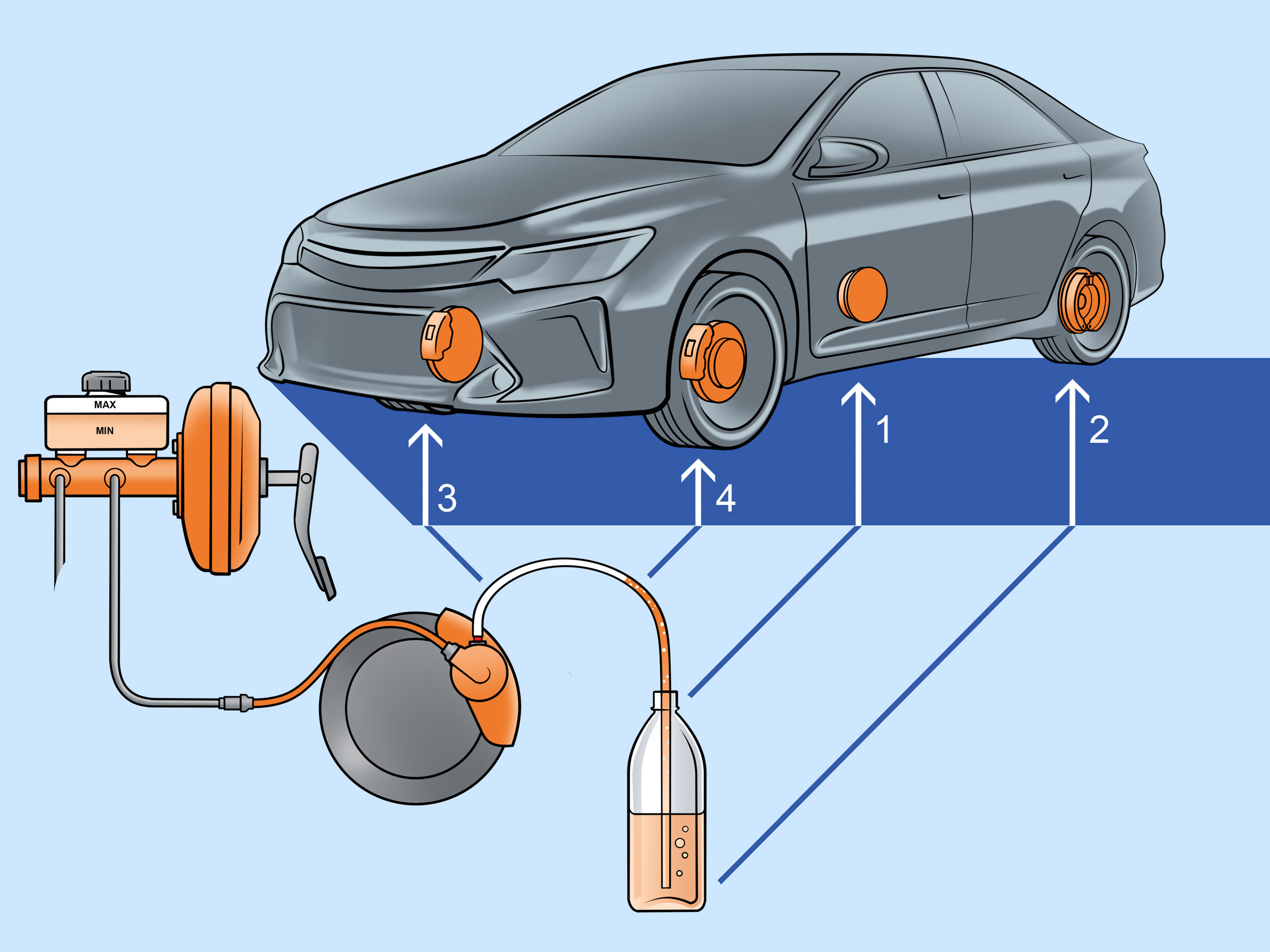
- Start at the wheel farthest from the master cylinder — typically the rear passenger side.
- Attach a clear bleed tube to the bleeder nipple and submerge the other end in a small jar of clean fluid.
- Have your partner slowly press the brake pedal to the floor and hold it.
- Open the bleeder screw with a wrench — you’ll see fluid (and possibly air bubbles) push through.
- Close the bleeder before your partner releases the pedal. This is critical — releasing while the screw is open sucks air back in.
- Repeat until no bubbles appear in the tube.
- Move to the next wheel: rear driver’s side, then front passenger, then front driver.
- Keep checking and refilling the reservoir — never let it run dry.
When the Ignition Needs to Be ON (But Engine Still Off)
Here’s where it gets more nuanced.
If your Mitsubishi has ABS, the ABS module contains its own set of valves and a small pump. Air can get trapped in this module during a regular bleed because the standard method never activates those valves. The fluid sitting in the ABS unit never fully moves.
To bleed the ABS module properly, you typically need:
- Key in the “ON” position (engine still off) — do you bleed brakes with car on or off powers the ABS control module
- An ABS-capable scan tool — to run the ABS motor and cycle the solenoid valves
Without activating the ABS module, you might bleed every wheel perfectly and still end up with a spongy pedal — because the air is hiding in the ABS unit, not the calipers.
Most professional shops use a bi-directional scan tool for this. If you’re doing it at home, some higher-end OBD-II tools support ABS bleed cycles. Budget tools typically don’t.
Signs that your ABS module needs bleeding (not just the calipers):
- Pedal feels spongy even after a thorough four-wheel bleed
- Brake pedal pulsates oddly on firm stops
- ABS activates at low speeds where it normally wouldn’t
When the Engine Should Actually Be Running
There’s one scenario where you genuinely need the engine running: bleeding a brake booster on vehicles with hydraulic (not vacuum) boosters, like certain larger trucks and SUVs. This is rare on most Mitsubishi models, but worth knowing.
For standard Mitsubishi passenger cars and performance vehicles, this doesn’t apply. Keep the engine off.
Common Mistakes That Ruin a Good Bleed
Letting the Reservoir Run Dry
If the master cylinder reservoir empties during bleeding, you’re pumping air directly into the system — which is the exact problem you’re trying to fix. Check it every two to three wheels.
Opening the Bleeder While the Pedal Comes Up
The bleeder screw must be closed before your partner releases the brake pedal. Period. Open it on the press, close do you bleed brakes with car on or off before the release. This is the most common error beginners make.
Using Old or Contaminated Fluid
Brake fluid absorbs moisture over time. If the fluid coming out of your bleeder looks dark brown instead of clear/light yellow, your whole system needs a flush — not just a bleed. Fresh DOT 4 fluid should look nearly clear.
Wrong Bleeding Order
Always start farthest from the master cylinder and work your way closer. On most vehicles: rear passenger → rear driver → front passenger → front driver.
Skipping the ABS Module
As mentioned, if you have ABS and you skip the module activation step, you may chase a soft pedal for weeks without ever fixing it.
Choosing the Right Brake Fluid for Your Mitsubishi
Mitsubishi vehicles predominantly use DOT 3 or DOT 4 brake fluid. DOT 4 has a higher boiling point and is the better choice for performance driving — especially relevant for Lancer Evolution owners who push their cars hard.
Never mix DOT 3/4 with DOT 5. DOT 5 is silicone-based and completely incompatible with the rubber seals and components used in standard Mitsubishi brake systems. It will cause swelling, deterioration, and brake failure.
If you’re sourcing quality Mitsubishi-specific parts and fluids, Mitsubishi Autostore is a solid resource. They specialize in genuine and premium aftermarket parts for Mitsubishi models including the Eclipse, Galant, and Lancer Evolution — everything from brake components to engine parts and rims. It’s the kind of place worth bookmarking if you work on your own car.
How Often Should You Bleed Your Brakes?
Most mechanics recommend bleeding your brakes every two years, or whenever:
- You replace brake pads or rotors
- You open any part of the hydraulic system (calipers, lines, master cylinder)
- The brake pedal feels soft or spongy
- You’ve done any hard track driving or towing
- The fluid appears dark or discolored
On high-performance Mitsubishi vehicles like the Evo, more frequent fluid changes are worth considering — brake fade from boiling fluid is a real issue during spirited driving.
Quick Reference: Car On or Off?
| Bleeding Method | Engine State |
|---|---|
| Gravity bleed | OFF |
| Two-person manual bleed | OFF |
| Vacuum/pressure bleed | OFF |
| ABS module bleed (scan tool) | Key ON, engine OFF |
| Hydraulic booster bleed (rare) | Running |
Final Word
So — do you bleed brakes with car on or off?
The answer to do you bleed brakes with car on or off is simple for most vehicles: keep the engine off during the bleeding process.
For the vast majority of situations, do you bleed brakes with car on or off has a straightforward answer — off. Turn the key to the “on” position only if you’re specifically bleeding an ABS module with a scan tool.
Running the engine during a standard brake bleed adds risk without adding any benefit, which is why understanding do you bleed brakes with car on or off is important for both safety and proper brake performance.
Brake maintenance is one of those jobs where doing it right the first time genuinely matters. A spongy pedal isn’t just an inconvenience — it can be a serious safety issue. This is another reason drivers ask do you bleed brakes with car on or off before starting the job.
Taking your time, using quality brake fluid, and following the correct bleeding order can make a huge difference in results. Knowing do you bleed brakes with car on or off is part of performing the procedure correctly.
Don’t skip the ABS bleeding step if your car has an anti-lock braking system, as this can affect pedal feel and braking performance. In some ABS procedures, do you bleed brakes with car on or off may require the ignition to be in the “on” position while using a scan tool.
By following manufacturer recommendations and proper procedures, you’ll never have to wonder again do you bleed brakes with car on or off when servicing your vehicle’s braking system.
If you’re working on a Mitsubishi and need replacement brake components, master cylinder parts, or anything else specific to your model, check out Mitsubishi Autostore. They carry a solid inventory of Mitsubishi-specific parts across the Eclipse, Galant, Lancer Evolution, and more — with a focus on quality that matches the engineering these cars were built with.Drive safe out there.